
Understanding Stein am Rhein history in layers
Stein am Rhein history starts long before the painted house fronts around Rathausplatz. The town's historical account identifies permanent settlement traces from the fifth millennium BC, with pile-dwelling settlements on the shallow shores of the Untersee, including Werd. The familiar old town belongs to a much later part of that story. Thinking in layers helps connect the landscape, religious institutions and town buildings without assigning them all to the same period.
For a visit, distinguish archaeological evidence from written references, the growth of the medieval town and the domestic life presented in a museum. Each answers a different question. The sightseeing guide covers what to visit today; this chronology explains how those places relate in time. It is particularly useful when the town's strongly historic appearance encourages a quick description of everything as medieval.
Tasgetium and settlement around the lake outlet
The Roman settlement of Tasgetium lay in neighbouring Eschenz, with a late Roman fortification on the hill called Burg. Keep that location distinct from today's Rathausplatz. The hill named in this Roman context is also separate from Hohenklingen Castle above the town. The wider area contains several historical sites whose names and positions should not be folded into a single castle or settlement.
Archaeological documentation identifies Neolithic and Bronze Age lakeshore settlements on Werd. These findings concern earlier occupation of the area, rather than a promise of an open-air excavation to explore on a present-day visit. Werd's inhabited monastery island belongs to the site's later history. A useful way to read the landscape is to keep those earlier settlement traces in mind while following the access information for the place as it is today.
A guided visit to Stein
This private trip includes guided sightseeing and free time in the historic town.
Hand-picked tours, booked through GetYourGuide. Prices are indicative starting prices in Swiss francs (as of October 2026). Tap a tour for live availability and the current price in your currency.

Visit Stein with guided sightseeing
A private excursion from Zurich includes guided sightseeing and free time in Stein plus Rhine Falls viewing platforms. It is a town visit, with museum admission arranged separately.
Otmar and the reference around 835
Otmar died on Werd in 759. A chapel was established at the former burial place in the tenth century. The town identifies the Otmar legend, written around 835, as its earliest mention. The date therefore belongs to a particular written tradition. It answers a different question from the age of the earliest settlement traces or the later record of a monastery donation.
Werd lies in the island group at the lake outlet. A wooden footbridge now leads to the inhabited monastery island, providing a present-day geographical connection with the Otmar story. Plan any island visit using local access information. Keep it separate from St Georgen in the town itself, and avoid treating the surrounding islands as one unrestricted sightseeing circuit.
The monastery donation of 1007
On All Saints' Day in 1007, Henry II donated the Benedictine monastery, already relocated to Stein, to the Bishopric of Bamberg. This is the event attached to that date. Calling 1007 the unqualified beginning of settlement would lose both the earlier written reference and the much older archaeological evidence. The distinction makes a more useful chronology than a single supposed founding year.
St Georgen was dissolved during the Reformation. Its later role is now that of a museum, with a late Gothic cloister and a ceremonial hall containing an early modern painted cycle. These spaces bring different artistic periods into a visit to the former abbey. The complex has belonged to the Swiss Confederation since 1926 and is now a museum of the Federal Office of Culture.
The medieval town and its political choices
Stein developed into a town in the thirteenth century, with a new Rhine bridge and town walls. These changes place its urban development within a physical setting: a settlement beside the river gaining the structures associated with a town. They also give context to a modern walk that moves between the river and the old town streets.
In 1457 the citizens purchased the rights of lordship. A protective alliance with Schaffhausen and Zurich followed in 1459, and the connection with Zurich was renewed in 1484. These dates describe separate political steps. Keeping the purchase of rights distinct from the alliances makes the sequence easier to follow and avoids reducing the town's changing position to one event.
Reading the painted facades
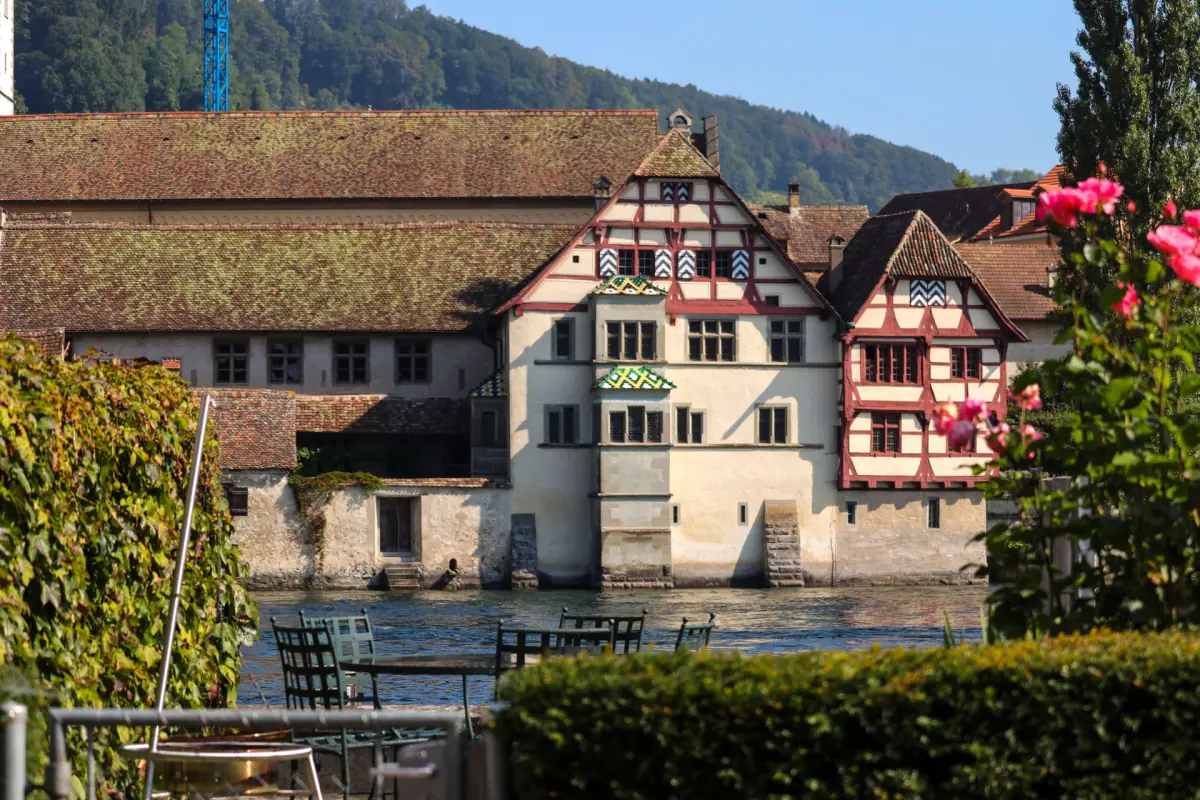
The bay windows and facade paintings of Rathausplatz make the historic town visually distinctive, but the present appearance should not be assigned wholesale to the Middle Ages. A decorated wall does not establish that every visible painting is a medieval original. Look at individual architectural and painted features as part of a town whose buildings have continued to change over time.
Lindwurm and the Biedermeier period
Museum Lindwurm focuses on middle-class living and agricultural work in the nineteenth century. The Biedermeier period is approximately 1815 to 1848. The building itself dates to 1279, its facade was remodelled in 1819/1820, and the rear building dates to 1712. The difference between the age of the house and the period represented inside is especially helpful here: an old structure can contain evidence of a much later way of life.
When turning this chronology into a museum itinerary, work with the visitor calendars. Lindwurm has winter weekend opening, interrupted by its closure from 21 December 2026 to 8 January 2027. St Georgen's 2026 season ended on 1 November. The seasonal guide helps match interests to dates. An organised excursion can include guided town sightseeing, while museum visits remain separate arrangements; the private visit described here is not a specialist history tour.
Questions about the town's past
What happened in 1007?
Henry II donated the Benedictine monastery, already relocated to Stein, to the Bishopric of Bamberg. Earlier settlement evidence and the Otmar legend belong to other stages of the area's history.
Why does 1457 matter?
The citizens purchased the rights of lordship that year. The protective alliance with Schaffhausen and Zurich followed in 1459, with the Zurich connection renewed in 1484.
Which period does Lindwurm show?
The museum presents middle-class domestic life and agricultural work in the nineteenth century, with the Biedermeier period understood as approximately 1815 to 1848.